
How Big Is the Early Advantage in 2026, Really?
- By David Reynaldo
- In Applying Early
Is Applying Early Still Worth the Rush in 2026?
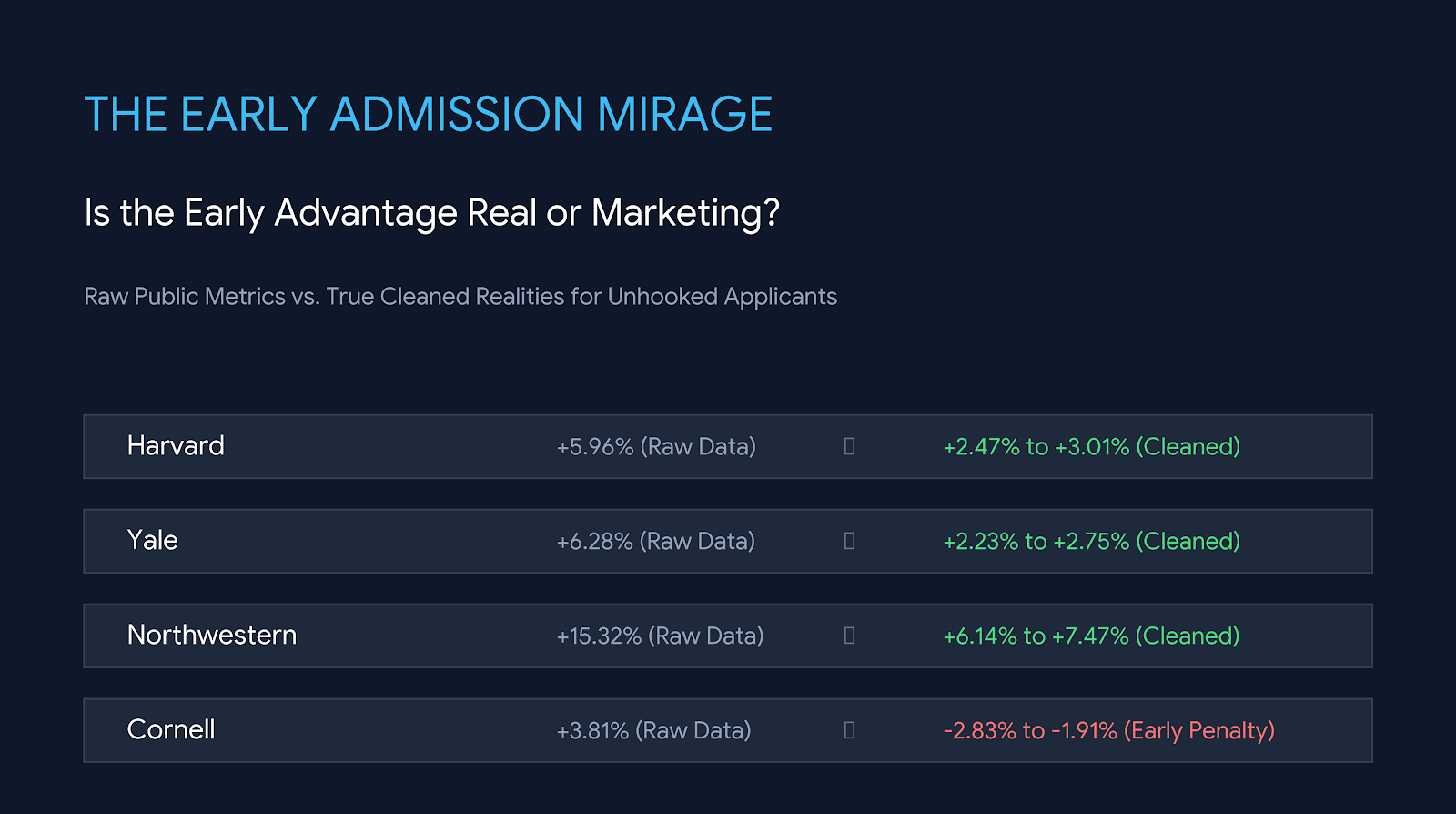
Early advantage is more hyped in 2026 than ever. However, none of the experts who tell you to apply early for a no-brainer advantage clean official data to remove recruited students and non-viable applicants. If that were to happen, the early advantage for you can shrink significantly—perhaps even disappear or, at worst, turn into an early penalty.
The Truth About the Early Advantage in 2026
A Smarter, More Nuanced Look at Early Advantage, By Type
College Zoom offers the most practical analysis of early admissions because we strip away the statistical noise. By cleaning official data to exclude recruited athletes and institutional special admits, we isolate the true advantage available to "normal," academically competitive applicants.
This article examines how the true early advantage breaks down across five distinct tracks:
- Early Decision - Single Round
- Early Decision I & II
- Early Action
- Restrictive Early Action (also known as Single-Choice Early Action)
- Rolling Admission
How "Polluted" Official Data Confuses Your Early Strategy
When Northwestern University publishes a 23% Early Decision acceptance rate alongside a 7.7% Regular Decision rate, most families—including experts—take those numbers at face value. They look at that massive statistical gap and assume applying in November is an absolute no-brainer.
But that conclusion fails Statistics 101. The raw data is so heavily polluted by recruited athletes and institutional priority admits that it completely distorts the actual odds for the normal, institutionally unhooked applicant.
When you strip away that noise and clean the data, Northwestern’s true early advantage shrinks dramatically to a modeled 4.93% to 6.14%. Recognizing this realistic margin completely changes the calculus: suddenly, rushing an application in November might not make nearly as much sense as waiting to submit a much stronger college application in January that isn't rushed.
How a University's Scoring Rubric Should Factor Into Your Decision
When Harvard was sued in federal court, its internal scoring rubric was exposed and an unprecedented trove of admissions data was laid bare.
Harvard's exposed data revealed that regardless of when a student applied (early vs regular), the application's ability to score high in multiple categories of Harvard's scoring rubric was the single greatest predictor of acceptance.
The data showed:
High ratings in 4 of 5 categories: 68% acceptance rate
High ratings in 3 of 5 categories: 43% acceptance rate
High ratings in no categories: 0.1% acceptance rate (virtually dead on arrival)
It’s vital to understand this before we dive into the strategy table below.
At nearly all highly selective colleges, upwards of 70% of early applicants are flat-out denied or deferred because their rubric score is based on what you share in your application—not the deadline you apply by.
If rushing to meet a November 1st deadline forces you to submit a 2-category application, instead of a 3-category application, you are actively under-cutting your odds of acceptance by an order of magnitude—far negating the early advantage you hoped to capture.
Most students don't realize that the Common App's essays make up only about 40% of the written real estate available to them for each college. The remaining 60% is often wasted on bland, literal answers to the Common App’s generic prompts, designed to accommodate thousands of non-selective colleges. To stand out at the top 50, you should use that hidden 60% of real estate strategically, rather than answering them at face value.
Summarized Findings
Summarized general findings below.
| Enrollment Strategy | Key Generalized Findings / Notes |
|---|---|
| Single-Round Early Decision (Lone ED) |
|
| Two-Round Early Decision (ED I & ED II) |
|
| Single-Choice Early Action (Restrictive EA) |
|
| Early Action (EA) |
|
| Rolling Admission |
|
Methodology: Who Did We Remove From the Early Stats?
If you're a normal, academically competitive applicant who has no special consideration or athletic recruitment pulling you in, we cleaned the data to isolate students like you.
Up to 30% of the early admission pool is compromised by candidates whose seats are effectively guaranteed or heavily protected by institutional priorities. This includes:
Recruited Athletes: Functionally pre-admitted through athletic department scouting.
QuestBridge/POSSEE Scholars: Growing in numbers since affirmative action became illegal.
- Faculty/Staff Dependents: May have a slightly lowered bar for admission.
VIPs: On a special list that gets concierge attention.
You'll understand your true odds once these students are removed from the calculation.
Regular Decision Data Was Cleaned, Too
At Top 20 universities, the Regular Decision data is equally distorted, but for the opposite reason. Most families are shocked to discover that 40% to 50% of the entire applicant pool is academically non-viable—meaning they are effectively dead on arrival. These uncompetitive applications serve as statistical padding, artificially driving down public acceptance rates to inflate a university’s brand equity. Once we distribute this non-viable pool between the early and regular rounds, the true Regular Decision acceptance rate for qualified applicants can effectively double.
How Polluted Data Foils Your Early Application Strategy
If Northwestern's early advantage were truly 15.3%, that would indicate that Northwestern ED effectively dropped into a lower tier of competition, momentarily lowering the bar of admission for early applicants. In effect, they would be accepting students of a caliber that belong in the next league down. But with a true early advantage of only 4.93% to 6.14%, the students earning the acceptances are virtually the same ones as those earning the same rubric evaluations in regular.
The University Is Not Your Friend: Don’t Accept Its Data at Face Value
A former admissions dean I met through NACAC (National Association for College Admission Counseling) explained that admissions deans curate data to influence applicant behavior—just like how CEOs curate earnings reports to influence the stock market. You owe it to yourself to separate truth from college propaganda if you want to make a binding early application count.
But Wait, Isn't 30-50% of the Class is Filled Early?
This is the ultimate institutional illusion. To see through the marketing, you must understand the difference between matriculants (students who enroll) and acceptances (the total number of admission offers extended).
While it is technically true that 56% of Northwestern University's enrolled Class of 2028 was comprised of Early Decision matriculants, only 22% of Northwestern's total acceptance letters were handed out during the early round. Here is why the "percentage of the class filled early" metric is so misleading: it completely ignores the massive volume of Regular Decision applicants who were accepted but chose to go elsewhere.
At Top 15 and Ivy+ colleges: For every single early student who enrolls, the university accepts roughly two Regular Decision students.
At less selective colleges: For every single early student who enrolls, the university accepts three to four Regular Decision students.
When you clean the data to focus on total acceptances—which represents your actual probability math problem as an applicant—the real Northwestern split looks like this:
22% of total acceptances are awarded Early
78% of total acceptances are awarded Regular
Now you know better.
But Still, Isn't the Regular Applicant Pool Exponentially Larger?
A massive applicant pool doesn't inherently mean tougher competition—especially when:
- Up to half of those Regular Decision candidates are academically dead on arrival, and
- Elite universities do not lower their baseline standards just because a student applies early.
When you clean the data and pit viable applicants against each other, the dramatic gap between early and regular admission rates largely evaporates:
The Early Pool: The official, raw ED admit rate of 23% shrinks to a realistic 17% to 19% once institutional hooks are removed.
The Regular Pool: The official, raw RD admit rate of 7.7% effectively doubles to a realistic 13% to 16% once non-viable applications are purged.
Ultimately, the maximum strategic advantage of applying early for a standard, qualified applicant is 6% at most—not the inflated 15.3% gap deduced from the university's raw data.
How Many Early Applicants Got the Boost?
To put this into perspective: the raw metrics imply that 789 students were accepted solely because they applied in November. In reality, our adjusted math reveals that no more than 270 students secured admission because of the early timeline. While a 6% bump is absolutely a real tactical advantage, it is less than half the size of its surface-level impression—and it only rewards a very specific type of applicant.
Applicants with Multi-dimensional Excellence Realize the Boost
Most students default to an internal sense of “doneness,” finishing personal statements when the story feels authentic or passes the English teacher test. But emotional resonance doesn’t always translate to competitiveness on admissions office rubrics, where strategic positioning, intellectual vitality, and multidimensional impact carry more weight.
A Yale admissions officer once said, "Sometimes we admit applicants with essays that most people would consider conventionally bad. Other times we reject applicants who wrote stylistically fantastic essays."
NotesThe early pool: Data from official university disclosures, athletic departments, QuestBridge, POSSE, and admissions officer statements. When data was incomplete—known data points from near peer institutions with similar admissions pool characteristics were used as reasonable, evidence-based adjustments. Non-viable applicants: Multiple analyses run with low (40%) vs high (50%) non-viable candidate assumptions, distributing 10-25% of the non-viables to the early round. |

You may also like

Top 3 Myths About the UC Application Deadline
- November 28, 2019
- by David Reynaldo
- in Applying Early